
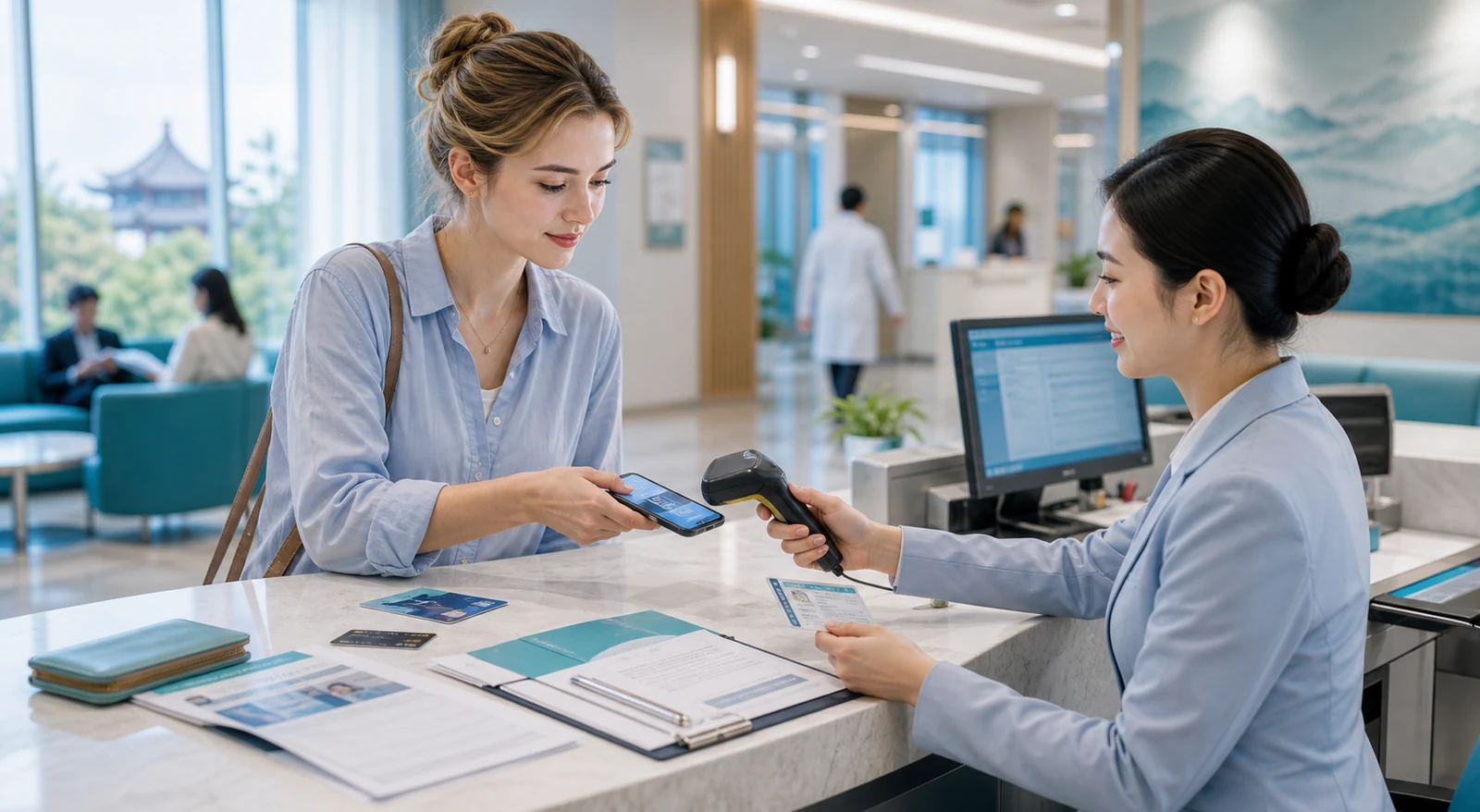
Hospital payment in China becomes much easier once you understand one basic rule: payment often happens in stages. A normal visit may include a registration fee, a consultation fee, separate test or imaging payments, medicine payment, and an admission deposit if the doctor recommends hospitalization. The exact route depends on the hospital, department, and whether you use a standard public clinic, an international department, or a private facility.
If you arrive expecting one final checkout after everything is done, the visit can feel more confusing than it really is. The hospital is not necessarily adding surprise charges at random. It may simply be asking you to pay each order before the next step can happen.
What to set up before the visit
Before you leave for the hospital, have your passport, appointment confirmation, one payment method that already works in China, one backup payment method, insurance card or policy details if relevant, and a phone that can receive verification messages.
Large hospital billing guides, including Mayo Clinic’s patient billing and estimate pages, consistently tell patients to confirm insurance requirements before the visit and to expect payment responsibility to change if the care changes. That mindset matters in China too. You do not want to discover at the cashier that your only card, app, or insurance assumption does not work for this specific route.
The most common payment flow
A first visit often follows the same pattern. You register or check in, pay the registration fee, see the doctor, pay for any ordered tests, scans, or treatment items, go to the test area or pharmacy, return if same-day results need review, and pay an inpatient deposit if you are admitted.
So yes, one hospital visit can involve several separate payments. That is normal in many outpatient workflows, especially in public hospitals.
Which payment methods are most realistic
Common methods include WeChat Pay, Alipay, Chinese bank cards, cash in RMB, and sometimes international credit cards. The safest assumption is not that everything digital will work. The safer assumption is that digital payment may work well, but you still need a backup.
Foreign cards and mobile payment setups can behave differently at hospital counters, self-service machines, and pharmacies. Official visitor guidance confirms that overseas cards can be linked to Weixin Pay and Alipay, but that does not guarantee that a particular hospital counter, kiosk, department, or inpatient-deposit route will accept your preferred method. If possible, test your payment setup before the hospital day, not during it.
The payment checklist to confirm with the hospital
Before travel, ask the hospital or international department for answers to these specific questions:
| Question | Why it changes the visit |
|---|---|
| Can a foreign passport holder complete registration without a Chinese ID? | Some online and kiosk flows are tied to local identity checks. |
| Which methods work at the cashier, pharmacy, and inpatient desk? | Acceptance can vary inside one hospital. |
| Are tests paid before they are performed? | This determines the order of a same-day visit. |
| Is direct billing available for this insurer and department? | An insurer's general network listing is not enough. |
| Which receipts and itemized records can be issued in English or Chinese? | Claims and later records requests are easier with complete paperwork. |
Public hospitals and international departments do not feel the same
At a regular public hospital, payment can feel fragmented. You may move between registration, consultation, cashier or kiosk, test department, and pharmacy. At an international department or private hospital, payment is often more coordinated and staff may guide you in English, but the fee level is usually higher.
Can insurance work directly
Sometimes, but direct billing usually depends on the insurer, the exact hospital, the exact department, the service being used, and whether pre-authorization is needed. Mayo Clinic’s international financial guidance makes the same point in a different setting: insurance acceptance does not remove the need to verify coverage, authorization, and payment rules in advance.
In China, direct billing is more common in private hospitals, international medical departments, and selected partner facilities. It is much less common in standard public outpatient clinics, where the patient often pays first and claims later.
Questions to ask before you arrive
These questions matter more than broad promises: can foreign bank cards be used at the cashier, is mobile payment required for any part of the visit, is direct billing available in this department, do tests need to be paid before they are performed, is a deposit required for admission or surgery, and do you need to collect paper receipts for claims?
Try to get the answer for the department you will actually use. A hospital may handle payment one way in an international department and another way in the standard public clinic.
What delays patients most
Payment usually slows down for predictable reasons. The hospital app needs verification that was never set up. The card works in shops but not in the hospital system. The patient expected direct billing but the department is not covered. The patient did not realize tests and medicine are paid separately. Or the self-service machine simply does not handle the foreign card.
What to keep after every payment
Do not leave empty-handed after a payment step. Keep the receipt, the order slip, the medication slip, the invoice if available, and the diagnosis or discharge summary when relevant. If you may file an insurance claim later, those papers matter more than your memory of what happened.
If payment fails on the day
If your first payment method fails, go to the manual cashier instead of staying trapped at the kiosk. Ask whether cash is accepted, whether another card can be used for that order, and contact your insurer if direct billing was expected. Keep the unpaid order details while you sort it out.
In many hospitals, tests, treatment, or medicine pickup stop until the order is paid. Treat payment failure as an active workflow problem, not something to fix later.
A simple payment rule
For a first visit in China, go in with one primary payment method, one backup payment method, and one clear understanding of whether your insurance is direct billing or reimbursement-only.
That is usually enough to avoid the most common payment problems.
Next step
If you want to estimate likely spending for consultation, tests, medicine, and admission, go to .
If you are still comparing hospitals and support levels, go to .
If you want payment, records, and timeline organized into one checklist, go to .
Sources and review note
Payment options change, so confirm the exact hospital route before travel. This guide was reviewed on July 17, 2026 against , the , and . Those sources support foreign-card linking and mobile-payment availability; they do not promise that every hospital workflow accepts every method.